The real state of RV park WiFi in 2026
Most RV park WiFi is not good enough for modern internet use. Most parks offer some form of WiFi, but the advertised "free high-speed internet" usually means a single consumer-grade router shared across 50-200 sites.
The problem is not the WiFi signal itself — it is the backhaul. Most parks connect to a DSL or low-tier cable line with 50-100 Mbps of total bandwidth. Divide that among 100 rigs on a Friday night and you are looking at under 1 Mbps per site. Even parks that have invested in better infrastructure often throttle individual users to protect overall network stability.
When weighing your RV park internet options, here is how the main choices — including starlink rv park wifi — compare in real-world conditions:
| Factor | Free campground WiFi | Paid campground WiFi | Starlink Roam | Cellular hotspot |
|---|---|---|---|---|
| Typical speed | 1-5 Mbps | 10-25 Mbps | 20-100 Mbps | 10-50 Mbps |
| Latency | 30-150 ms | 20-80 ms | 25-60 ms | 30-80 ms |
| Reliability | Poor — drops during peak | Moderate | Good | Good in coverage |
| Monthly cost | Free | $5-10/day | $55-175/mo | $50-100/mo |
| Security | None (open network) | WPA2 shared key | Private network | Private network |
| Works everywhere | Only at parks | Only at parks | Anywhere with sky view | Cell coverage only |
In short: when comparing campground WiFi vs Starlink, the free option works for checking email and light browsing. Anything beyond that requires either a paid tier, your own Starlink dish, or a cellular backup.
Some premium resorts and newer parks have started offering fiber-backed WiFi with paid tiers delivering 25-50 Mbps. These are the exception, not the rule. If you want to know whether Starlink is worth it for full-time RV life in 2026, the answer usually comes down to how much you rely on campground WiFi.
How to test campground WiFi before you commit
Run a speed test within 15 minutes of connecting — do not trust the park's advertised speeds. Use fast.com or Speedtest.net on your phone or laptop and test at two times: once during the afternoon and once after 7 PM when usage peaks.
Here is what you need for common activities:
| Activity | Minimum speed needed | Campground WiFi likely? |
|---|---|---|
| Email and web browsing | 1-2 Mbps | Yes |
| Social media with video | 3-5 Mbps | Sometimes |
| SD streaming (Netflix, YouTube) | 5 Mbps | Rarely at peak |
| HD streaming | 10-15 Mbps | Only paid tiers |
| 4K streaming | 25 Mbps | Almost never |
| Zoom/Teams video calls | 3-5 Mbps up and down | Rarely reliable |
| Remote work (VPN, file uploads) | 10+ Mbps with low latency | Only premium parks |
| Online gaming | 5+ Mbps with under 50 ms ping | Almost never |
Red flags that campground WiFi will not meet your needs:
- No password on the network. Open networks are both slow and insecure.
- Multiple SSIDs with "Guest" in the name. This usually means heavy throttling.
- Signal strength below -70 dBm at your site. Even a booster cannot save a signal this weak.
- Ping times above 100 ms. High latency makes video calls and VPNs unusable regardless of download speed.
- The park advertises "WiFi at the clubhouse." This means the access point is centralized and your site is likely too far away.
Track your data consumption with a Starlink data usage guide so you know exactly how much bandwidth your household actually needs.
Best RV park WiFi booster and extender options
A WiFi booster captures the park's signal with an external antenna and rebroadcasts it inside your RV with a stronger, cleaner connection. This helps when the park WiFi is decent at the source but your site is far from the access point.
The critical thing to understand: a booster amplifies signal, not bandwidth. If the park has 5 Mbps total and 80 rigs are connected, a booster gives you a stronger connection to that same 5 Mbps pipe. It does not create more bandwidth.
That said, a booster paired with a travel router is one of the best investments for RV park stays. The travel router creates your own private network, adds firewall protection, and lets you connect all your devices to one SSID. Check our guide to the best travel routers for Starlink RV setups for detailed comparisons.
Top picks for boosting park WiFi

TP-Link RE315 WiFi Extender
WiFi Extender
$22.97
Amazon price when we checked on Oct 9, 2026
Check today's price on Amazon(opens Amazon in a new tab)The TP-Link RE315 is the budget option at $20-30. It works as a range extender that captures the park WiFi and rebroadcasts it. Simple setup, compact enough to plug into any RV outlet. Best for casual users who just need email and browsing on park WiFi.

WAVLINK AX1800 Outdoor WiFi 6 Extender (2026)
Outdoor WiFi AP
$159.99
Amazon price when we checked on Oct 9, 2026
Check today's price on Amazon(opens Amazon in a new tab)The WAVLINK AX1800 is the serious option at $150-185. It mounts outside your RV with weatherproof housing and high-gain antennas that reach park access points hundreds of feet away. WiFi 6 support means faster throughput to the park network. This is what full-timers use.
Pairing a booster with a travel router
For the best campground WiFi experience, pair an outdoor booster with a travel router. The booster grabs the park signal, feeds it to the router via Ethernet or WiFi repeating, and the router creates your private secured network inside the RV.

GL.iNet GL-MT6000 Flint 2
Travel Router
$169.99
Amazon price when we checked on Oct 9, 2026
Check today's price on Amazon(opens Amazon in a new tab)The GL.iNet Flint 2 at $160-190 is the top travel router choice. It supports WAN failover between WiFi (campground), Ethernet (Starlink), and tethered cellular — so it can automatically switch sources when one fails. Learn how to extend Starlink WiFi range in your RV using a travel router for complete coverage.
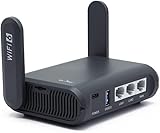
GL.iNet GL-AXT1800 Slate AX
Travel Router
$119.99
Amazon price when we checked on Oct 9, 2026
Check today's price on Amazon(opens Amazon in a new tab)The GL.iNet Slate AX at $110-140 is a more portable alternative that does the same multi-WAN trick in a smaller package. Great if you move between a tow vehicle and the RV frequently.
When to skip park WiFi and use your Starlink dish
Park WiFi makes sense for light browsing at well-equipped resorts. But there are clear situations where setting up your own dish is the better call.
Use your Starlink dish when:
- You work remotely and need reliable video calls or VPN access
- You stream more than an hour of video per day
- The park has no WiFi or only open, unsecured WiFi
- Speed tests show under 5 Mbps at peak hours
- You need upload speed (most park WiFi delivers under 1 Mbps up)
- You are staying more than 2-3 nights and want hassle-free connectivity
Stick with park WiFi when:
- The park offers paid WiFi delivering 25+ Mbps reliably
- You only need email, weather, and light browsing
- Your site has heavy tree cover or obstructions blocking satellite view
- You are staying one night and do not want to set up the dish
The cost math is straightforward. Starlink RV plans in 2026 start at $55/month for the 100GB Roam plan and go up to $175/month for Roam Unlimited with no data cap. If a park charges $10/day for premium WiFi and you stay 15 nights per month, that is $150 — nearly the same as Starlink Roam Unlimited, except Starlink works everywhere you go, not just at parks with good infrastructure.
How Starlink at RV parks actually performs
Starlink delivers 20-100 Mbps at most RV parks, with typical speeds around 30-60 Mbps. That is 5-30x faster than average campground WiFi. Latency sits around 25-60 ms, which is fine for video calls, gaming, and VPN use.
The main challenge at RV parks is sky view. Trees are the biggest enemy. Sites surrounded by tall pines or hardwoods can block enough of the northern sky to cut speeds significantly or cause frequent dropouts. Before choosing a site, open the Starlink app's obstruction checker to see how much clear sky you have.
RV park-specific setup tips:
- Request an end site or pull-through. These usually have fewer tree obstructions on at least one side.
- Use a tripod or flagpole mount to get the dish above RV roofline level. Even 3-4 feet of elevation helps clear nearby obstructions.
- Orient the dish toward the north if you have a choice of placement. Starlink satellites are denser in northern sky arcs at US latitudes.
- Power draw matters. The Standard Gen 3 dish pulls 75-100W (the Mini 20-40W). If you are on a 30-amp site, that is negligible. On battery power while boondocking between parks, check our Starlink RV boondocking guide for power management.
Congestion can affect Starlink at popular RV destinations. Places like Yellowstone gateway towns, Moab, and Florida Keys have high Starlink user density during peak season. You may see speeds drop to 15-30 Mbps during evening hours — still far better than campground WiFi, but not the 100 Mbps you might get in a less crowded area. Our full-time RV setup guide covers optimizing performance in congested areas.
The hybrid approach: starlink rv park wifi plus campground signal
The smartest setup uses both campground WiFi and Starlink simultaneously through a dual-WAN travel router. This gives you automatic failover and the ability to offload non-critical traffic to the free park WiFi while reserving Starlink bandwidth for important tasks.
Here is how the hybrid setup works:
- Connect your travel router to the park WiFi as the primary WAN (free bandwidth)
- Connect Starlink to the router via Ethernet as the secondary WAN
- Configure failover so the router switches to Starlink when park WiFi drops below a speed or latency threshold
- Route work VPN and video calls through Starlink; let software updates and background downloads use park WiFi
The GL.iNet Flint 2 and Slate AX both support this dual-WAN configuration out of the box through their admin panel. No command-line setup required.

EAZUSE Starlink Ethernet Adapter (Gen 3/Mini)
Ethernet Adapter
Waterproof SPX-to-RJ45 adapter for Starlink Gen 3 and Mini, adds a wired Ethernet port without cutting cables.
$26.09
Amazon price when we checked on Oct 9, 2026
Check today's price on Amazon(opens Amazon in a new tab)If you are using the Standard Gen 3 router, run a standard Ethernet cable from one of its two LAN ports to your travel router's WAN port. This is more reliable than WiFi bridging between the two routers.
For even more redundancy, add cellular as a third WAN source. A Starlink vs cellular hotspot comparison helps you decide whether to add cellular to your setup, and our guide to Starlink cellular failover for RV covers the full dual-internet configuration.
GL.iNet GL-XE3000 Puli AX 5G Router (dual SIM, 6400mAh)
Mobile Hotspot
A standalone cellular gateway with its own antennas, dual SIM slots and a 6,400mAh battery - it does the job of a mobile hotspot without draining your phone, and adds dual-WAN failover a hotspot cannot.
$390 – $460
Amazon price when we checked on Oct 9, 2026
Check today's price on Amazon(opens Amazon in a new tab)The GL.iNet Puli AX ($390-460) combines a travel router with a built-in 5G modem, dual SIM slots and a backup battery, giving you three WAN sources — campground WiFi, Starlink Ethernet, and cellular — in one device. It is the ultimate RV internet hub for full-timers who need maximum uptime. See our complete streaming and gaming setup guide for optimizing this configuration.
Staying secure on campground WiFi
Open campground WiFi is a security risk you should take seriously. When you connect to an unencrypted network shared with hundreds of strangers, your traffic is visible to anyone running basic packet-sniffing tools.
Real threats on open park WiFi:
- Packet sniffing. Anyone on the same network can capture unencrypted traffic, including login credentials sent over HTTP.
- Man-in-the-middle attacks. An attacker can position themselves between you and the access point, intercepting and modifying your traffic.
- Evil twin networks. Someone sets up a fake access point with the park's SSID. You connect to the attacker's network thinking it is the park WiFi.
- DNS spoofing. Redirecting your requests to malicious versions of legitimate websites.
How to protect yourself:
- Use a VPN on every device connected to campground WiFi. This encrypts all traffic regardless of the network's security. Our Starlink RV VPN security guide covers the best VPN options for RV setups.
- Connect through a travel router instead of directly to the park network. The router acts as a hardware firewall, creating a NAT barrier between the park network and your devices.
- Verify HTTPS on every site. Never enter passwords or credit card info on HTTP sites while on public WiFi.
- Disable auto-connect. Make sure your devices do not automatically rejoin campground networks without your knowledge.
- Use Starlink for sensitive tasks. Even with a VPN, routing banking, email, and work traffic through your private Starlink connection is safer than any public WiFi.
The bottom line: campground WiFi is acceptable for non-sensitive browsing with VPN protection. For anything involving money, work credentials, or personal data, use your own Starlink connection.
Making the right choice for your travel style
Your ideal RV park internet strategy depends on how you travel and what you need online.
Weekend warriors who stay at established parks 2-3 weekends per month can often get by with a WiFi booster and travel router. Total investment: $130-170 for hardware, zero monthly cost beyond what you already pay for campsite fees. Add a Starlink 100GB Roam plan at $55/month if park WiFi consistently disappoints.
Full-timers and remote workers need Starlink as their primary connection, period. The $175/month Roam Unlimited plan with no data cap is the cost of doing business on the road. Use park WiFi as a free backup through a dual-WAN setup, but never depend on it for income-producing work.
Seasonal travelers who split time between a home base and extended RV trips benefit from Starlink's Standby Mode. Run a full plan during your travel months and switch to Standby Mode ($10/month, basic access only) during months at home where you have fixed broadband. This brings effective annual cost down significantly compared to paying year-round.
Related reading
- Best travel routers for Starlink RV setups
- How to extend Starlink WiFi range in your RV
- Starlink vs cellular hotspot for RV
- Starlink RV plans and pricing in 2026
- Starlink RV VPN security guide
What to do next
Start by testing the WiFi at your next campground using the speed test checklist above. If speeds fall below 5 Mbps during peak hours — and they probably will — you have your answer. Grab a travel router and either a WiFi booster for marginal park networks or set up your Starlink dish for guaranteed performance. The hybrid approach with dual-WAN failover gives you the best of both worlds without manually switching between connections.