Why Starlink RV users need to think about security
Starlink is a shared satellite network. Your traffic travels from your dish to a satellite, then to a ground station, then to the internet. While SpaceX encrypts the satellite link, your traffic after the ground station is no different from any other internet connection — it can be intercepted, logged, or throttled.
Three specific scenarios make a VPN important for RV users:
-
Remote work: Your employer almost certainly requires VPN access to corporate resources. Starlink's CGNAT (Carrier-Grade NAT) means you share an IP address with other Starlink users, which can trigger corporate security alerts. A VPN gives you a stable, dedicated tunnel.
-
Campground WiFi fallback: When you connect to campground WiFi as a backup or supplement, you are on an open network with every other camper. A VPN encrypts all your traffic.
-
Personal privacy: Without a VPN, your ISP (Starlink/SpaceX) can see your DNS queries and traffic patterns. A VPN prevents this.
Understanding Starlink's network architecture
CGNAT: what it means for VPN users
On Roam and Residential plans, Starlink uses Carrier-Grade NAT (CGNAT) for IPv4, which means your Starlink connection does not have a unique public IPv4 address. Instead, many Starlink users share a single public IP. Two exceptions: Starlink hands every plan a globally routable IPv6 prefix, and Priority plans let you switch on a public IPv4 address under the subscription's IP policy setting.
This matters because:
- You cannot host services or accept incoming IPv4 connections
- Some websites and services flag shared IPs as suspicious
- Corporate VPN gateways may see traffic from multiple Starlink users appearing from the same IP, which can trigger security blocks
- Port-based VPN protocols may conflict with other users on the same CGNAT IP
Double NAT complications
If you run Starlink with its built-in router and then connect a travel router, you have double NAT — CGNAT from Starlink plus NAT from your router. This makes VPN connections even more challenging.
Solution: Enable Starlink bypass mode to eliminate one NAT layer. Your travel router then handles the single remaining NAT, and your VPN connects cleanly through it.
VPN setup option 1: router-level VPN (recommended)
The best approach for RV use is running the VPN on your travel router. Every device on your network is automatically protected — no per-device apps needed.
Required hardware
| Component | Recommended model | Price |
|---|---|---|
| Router | GL.iNet Flint 2 (GL-MT6000) | $160–$190 |
| VPN subscription | NordVPN, Mullvad, or Surfshark | $3–$12/mo |
Setup steps (GL.iNet router)

GL.iNet GL-MT6000 Flint 2
Travel Router
$169.99
Amazon price when we checked on Oct 9, 2026
Check today's price on Amazon(opens Amazon in a new tab)- Enable Starlink bypass mode — this eliminates Starlink's built-in router and NAT
- Connect the GL.iNet router to the Starlink ethernet port
- Open the GL.iNet admin panel at 192.168.8.1
- Navigate to VPN → VPN Client
- Select WireGuard as the protocol (fastest for satellite connections)
- Import your VPN provider's WireGuard configuration file — download this from your VPN provider's website
- Enable the VPN and verify the connection
- Test with a DNS leak test at dnsleaktest.com to confirm all traffic routes through the VPN
Split tunneling (route only some traffic through VPN)
Not all traffic needs VPN protection. Streaming services may block VPN connections, and routing everything through a VPN adds latency.
GL.iNet routers support VPN policies that let you choose which devices or websites use the VPN:
- Work laptop: Route through VPN (employer requirement)
- Streaming TV: Route directly (avoids geo-blocking issues)
- Phones: Route through VPN (privacy)
- Smart home devices: Route directly (low-security, latency-sensitive)
VPN setup option 2: per-device VPN apps
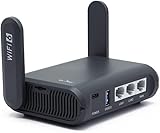
GL.iNet GL-AXT1800 Slate AX
Travel Router
$119.99
Amazon price when we checked on Oct 9, 2026
Check today's price on Amazon(opens Amazon in a new tab)If you do not use a travel router, install VPN apps directly on each device.
Desktop (Windows/Mac)
- Download your VPN provider's desktop app
- Select WireGuard or IKEv2 protocol in settings
- Enable the kill switch (blocks internet if VPN disconnects)
- Connect to the nearest VPN server for lowest latency
Mobile (iOS/Android)
- Download the VPN app from App Store or Play Store
- Enable "always-on VPN" in the app settings
- Configure split tunneling to exclude streaming apps if needed
Limitations of per-device approach
- Must install and configure on every device
- Some devices (smart TVs, streaming sticks) do not support VPN apps
- Each device adds its own VPN overhead
- Harder to manage consistently
Choosing a VPN protocol for Starlink
Not all VPN protocols perform equally over satellite connections. Starlink's unique characteristics — periodic handoffs, variable latency, and CGNAT — favor certain protocols over others.
Protocol comparison
| Protocol | Speed overhead | Latency added | Handoff recovery | Best for |
|---|---|---|---|---|
| WireGuard | 5–10% | 2–5 ms | Instant | General use, recommended default |
| IKEv2/IPSec | 10–15% | 5–10 ms | Fast (built-in mobility) | Corporate VPNs, mobile devices |
| OpenVPN (UDP) | 15–25% | 10–20 ms | Moderate (10–30 sec reconnect) | Legacy corporate requirements |
| OpenVPN (TCP) | 20–30% | 15–30 ms | Slow (30–60 sec reconnect) | Avoid on Starlink |
Why WireGuard is best for Starlink
WireGuard handles connection interruptions gracefully. During a Starlink satellite handoff (1–3 second drop), WireGuard's stateless design allows it to resume the connection instantly once the link returns — no full reconnection handshake required.
OpenVPN (especially TCP mode) interprets satellite handoffs as connection failures and begins a full reconnection process that can take 30–60 seconds. This compounds the handoff disruption.
Recommendation: Use WireGuard as your default. Switch to IKEv2 only if your employer's corporate VPN requires it.
Best VPN services for Starlink RV use
NordVPN — best overall for RV users
| Feature | Value |
|---|---|
| WireGuard support | Yes (NordLynx protocol) |
| Router support | GL.iNet, OpenWrt, others |
| Server network | 9,000+ servers in 130+ countries |
| Kill switch | Yes (all platforms) |
| Split tunneling | Yes |
| Price | $3–$5/mo (annual plan) |
NordVPN's NordLynx is its WireGuard-based protocol, with a double NAT system NordVPN adds so it does not need to store user IP addresses. The massive server network means you can always find a low-latency server near your location.
Mullvad VPN — best for privacy purists
| Feature | Value |
|---|---|
| WireGuard support | Yes (default protocol) |
| Router support | Any WireGuard-compatible router |
| Server network | About 580 servers in 50 countries |
| Kill switch | Yes |
| Split tunneling | Yes |
| Price | €5/mo (flat, no annual discount) |
Mullvad requires no email or personal information to sign up. You get an anonymous account number, pay with cryptocurrency if desired, and Mullvad publishes a no-logging policy. The flat €5/mo price with no commitment is ideal for seasonal RVers.
Surfshark — best budget option
| Feature | Value |
|---|---|
| WireGuard support | Yes |
| Router support | GL.iNet, OpenWrt |
| Server network | 4,500+ servers in 100 countries |
| Kill switch | Yes |
| Split tunneling | Yes (Bypasser feature) |
| Price | $2–$3/mo (2-year plan) |
Unlimited simultaneous connections means every device in your RV is covered on a single subscription.
Corporate VPN troubleshooting on Starlink
Many remote workers encounter issues with their employer's VPN over Starlink. Here are the most common problems and fixes.
Problem: VPN disconnects every few minutes
Cause: Starlink satellite handoffs cause 1–3 second interruptions. The corporate VPN client interprets these as connection loss.
Fix:
- Ask IT to increase the VPN dead peer detection (DPD) interval to 30–60 seconds
- Switch to IKEv2 protocol if available — it handles roaming and IP changes natively
- Use the Starlink app to check obstruction percentage — aim for under 2%
Problem: VPN connects but cannot reach internal resources
Cause: Double NAT from CGNAT + Starlink router + travel router creates routing confusion.
Fix:
- Enable Starlink bypass mode to eliminate one NAT layer
- Ensure your travel router is not running a VPN simultaneously with your corporate VPN
- Try connecting from a device directly on the Starlink network (no travel router) to isolate the issue
Problem: VPN connection is very slow
Cause: The VPN server is geographically far from the Starlink ground station.
Fix:
- Ask IT for a VPN gateway option closer to your physical location
- If using a personal VPN alongside corporate VPN, disable the personal one to avoid double encryption
- Test speed with and without VPN to isolate whether the bottleneck is VPN overhead or Starlink itself
Problem: employer blocks Starlink IP range
Cause: Some corporate security policies block connections from known CGNAT or satellite IP ranges.
Fix:
- Connect through a personal VPN first (which gives you a different, non-Starlink IP address), then launch the corporate VPN on top, if your employer's policy allows it
- Ask IT to whitelist SpaceX/Starlink IP ranges (AS14593)
- Use a cellular hotspot as a backup for VPN-critical work sessions
Security beyond VPN
DNS-level protection
Configure your travel router to use encrypted DNS (DNS-over-HTTPS or DNS-over-TLS) through providers like Cloudflare (1.1.1.1) or NextDNS. This prevents DNS queries from leaking even when the VPN is not active.
Firewall rules
Enable the firewall on your travel router. Block all incoming connections (Starlink CGNAT already does this, but a local firewall adds a second layer). Disable UPnP to prevent devices from opening ports without your knowledge.
Guest network isolation
If campground neighbors ask for your WiFi password, create a guest network on your travel router that is isolated from your main devices. Guest users get internet access but cannot see your computers, NAS, or other devices.
What to do next
Start with a GL.iNet travel router in Starlink bypass mode and a WireGuard VPN subscription. This single setup secures your entire RV network with minimal speed impact and handles satellite handoff interruptions gracefully.
- Set up bypass mode in How to extend Starlink WiFi range in your RV
- Compare travel routers with VPN support in Best travel routers for Starlink RV
- Optimize for remote work in Starlink RV full-time setup guide
Related reading
- How to extend Starlink WiFi range in your RV
- Best travel routers for Starlink RV
- Starlink RV full-time setup guide
- Starlink RV troubleshooting guide
Affiliate disclosure
This page may include affiliate links. If you purchase through them, we may earn a commission at no extra cost to you.