Buying a Starlink kit for your RV isn't complicated, but there are a few decisions that trip people up. Wrong dish. Missing accessories. Wrong plan. This guide covers everything you actually need to know before you buy — including exactly what's in the box, how the hardware specs compare, what mount to get, how much power you need, and which plan to pick.
What's included in the Starlink RV kit
Starlink doesn't call it an "RV kit" on the product page, but that's how most RV owners refer to the hardware bundle. You're buying either the Starlink Mini or the Starlink Standard Gen 3 and pairing it with a Roam plan for mobile use.
Here's exactly what ships in each box:
Starlink Mini kit ($249)
- Starlink Mini dish — 298.5mm × 259mm (11.75 × 10.2 in), 1.10 kg (2.43 lbs), IP67, with a WiFi 5 router integrated directly into the dish body
- Kickstand — clips onto the back of the dish for ground setups
- 15m (50 ft) DC cable — runs from the power supply to the dish's DC input (the Mini accepts 12-48V DC)
- AC power supply — converts wall power to the DC voltage the dish needs
- Quick start guide — fold-out card with setup steps and app download QR code
The Mini doesn't need a separate router. The dish is the router. That keeps the setup simple: one cable, one device, one power plug. The built-in WiFi covers most rigs up to about 30 feet from the dish.
What's NOT in the box: A mount. A weatherproof cable pass-through. A travel router. Any Ethernet cables beyond what's integrated. All of these are separate purchases.
Starlink Standard Gen 3 kit ($349)
- Gen 3 Standard dish — about 594mm × 383mm (23.4 × 15.1 in), 2.9 kg (6.4 lbs), IP67, with a kickstand. There are no motors: you aim it once with the app's guidance
- Separate Gen 3 WiFi 6 router — tri-band 802.11ax with two Ethernet LAN ports
- 15m (50 ft) Starlink cable — runs from the dish (exterior) to the router (interior). It uses RJ45-based connectors inside Starlink's sealed, latching housings; a standard Ethernet cable will connect but isn't weather-sealed
- Power supply for the router — the router powers the dish through the Starlink cable
- Quick start guide
The Gen 3 requires you to route the dish cable from outside to inside your rig. That's one extra step vs. the Mini, but it also gives you a more capable router, WiFi 6 performance, and two Ethernet ports for wired devices. Starlink rates the Standard at 75-100W average draw, and it pulls more in cold weather when snow melt runs.
What's NOT in the box: A mount. Ethernet cable longer than 15m (though you can use a coupler and Cat6). A travel router. A surge protector.
Starlink RV vs Residential vs Mini: full comparison
This is the question most buyers skip — and it matters more than any accessory choice.
| Feature | Mini | Gen 3 Standard | Residential |
|---|---|---|---|
| Hardware price | $249 | $349 | $349 |
| Dish size | 298.5 × 259mm | ~594 × 383mm | ~594 × 383mm |
| Weight | 1.1 kg | 2.9 kg | 2.9 kg |
| Router included | Built-in | Separate Gen 3 router | Separate Gen 3 router |
| Power draw (idle) | ~15W | Not published | Not published |
| Power draw (average) | 20-40W | 75-100W | 75-100W |
| Snow melt | Up to 25 mm/hour | Up to 40 mm/hour | Up to 40 mm/hour |
| WiFi standard | WiFi 5 | WiFi 6 | WiFi 6 |
| Ethernet ports | 1 latching LAN port on dish (sealed by Starlink Plug; cable sold separately) | 2 on router | 2 on router |
| Mobile use (Roam) | Yes | Yes | Best effort only away from home |
| Best for | Frequent movers, boondockers | Full-timers, heavy users | Homes only |
Key takeaway for RV buyers: Residential hardware is the same Gen 3 Standard dish at the same $349 price, but Residential service is tied to a home address. Away from that address it drops to "best effort," the lowest network priority, below every Roam plan, and it doesn't support in-motion use. Always buy Mini or Gen 3 Standard if you're an RV user. The Gen 3 hardware is identical to Residential; the difference is which service plans you can activate on it.
Starlink Standard vs Gen 3: what changed?
"Gen 3" refers to the third generation of the Standard dish, which reached US buyers in late 2023 and 2024. Starlink's spec sheet now calls the current version "Standard 4X." If you see older listings or used hardware, here's what changed:
- Gen 3 drops the motors. The Gen 2 "Standard Actuated" dish aimed itself with built-in motors. Gen 3 uses a kickstand or mount, and the app tells you which way to tilt it
- Gen 3 router supports WiFi 6 — the older Gen 2 router was WiFi 5 only
- Gen 3 router has two Ethernet ports built in — the Gen 2 router needed a separate Ethernet adapter
If you're buying new in 2026, you're getting Gen 3. The Gen 2 Standard Actuated dish is discontinued. It's fine to keep using one you already own, but don't buy one. The same goes for the old Flat High Performance dish: Starlink renamed it "Performance (Gen 2)" and replaced it with the Performance (Gen 3).
Monthly plan options: Roam vs Residential explained
This is where a lot of buyers make an expensive mistake. Here are all the plans relevant to RV use:
Roam 100GB — $55/month
- 100GB of full-priority data per month
- After 100GB, you drop to "basic access" (under 1 Mbps) until the billing cycle resets
- Domestic only: works across the US and Canada (one region), not Mexico
- Standby Mode available: pause service for $10/month, reactivate same day
- Best for: Weekend campers, occasional travelers, light users
Roam 300GB — $80/month
- 300GB of full-priority data per month
- The middle tier for travelers who routinely blow past 100GB but don't need unlimited
- Same basic-access slowdown past the cap, same domestic-only US/Canada coverage, and Standby Mode option
- Best for: Regular travelers, light remote workers, small families
Roam Unlimited — $175/month
- Unlimited data, no throttling
- Works across the US and Canada, plus the only Roam plan that works abroad (including Mexico), for up to 30 days per trip
- Standby Mode available
- Best for: Full-timers, remote workers, heavy streamers, Mexico travelers
Priority plans — $55 to $280+/month
- Local Priority is sold in priority-data blocks from $55/month (50GB) up to $280/month (1TB) and gets the highest network priority during congestion
- Global Priority starts at $250/month for continuous international travel; relevant mainly for business users
What Roam does NOT include
- International use on the 100GB and 300GB plans (only Roam Unlimited leaves the US/Canada region, 30 days per trip)
- Priority over Residential users at their home address during peak hours (Roam ranks below Priority and home Residential during congestion)
Standby Mode: the seasonal camper's secret weapon
If you camp seasonally, Standby Mode changes the math significantly. Instead of paying $175/month year-round ($2,100/year), you:
- Pay full rate during your 6 travel months: $1,050
- Pay ~$10/month during your 6 off months: $60
- Total annual cost: $1,110 vs. $2,100
That's roughly $990 in savings per year just by using Standby Mode. Reactivation takes effect the same day you turn it back on.
Mounting options: roof, tripod, ladder, and DIY
The dish needs a clear, unobstructed view of the sky — about a 110-degree cone, reaching down to roughly 35 degrees above the horizon. No mount comes in the box. Here are your real options:
Portable tripod mount
Best for: Weekend campers, frequent movers, anyone who wants flexibility
Set it outside wherever you have the best sky view. Works for any rig, takes up moderate storage space (most tripods collapse to about 3 feet). For a Gen 3 Standard, the ORWOD Gen 3 tripod stand raises the dish to roughly 32-37 inches. It fits the Standard only; Mini owners should look at a Mini tripod mount instead.
- Pros: No drilling, works anywhere, easy to reposition
- Cons: Takes up exterior storage, cable runs along ground, can be knocked over
Ladder/hitch-rack mount
Best for: Class A, Class C, and travel trailers with rear ladders or cargo carriers
Clamps to the rear ladder or hitch-mounted cargo rack. No roof drilling required. The no-drill ladder clamp is the most popular permanent-but-removable option.
- Pros: No roof penetration, easy removal, keeps dish accessible
- Cons: Rear obstruction from trees behind you, dish sits low
Roof mount (permanent)
Best for: Full-timers who want set-and-forget, maximum elevation and sky view
Requires drilling into the roof or using existing roof penetrations. Most secure option for long-term use. You'll need a roof penetration kit to waterproof the cable entry point.
- Pros: Best sky view, cable hidden, most secure
- Cons: Roof drilling, harder to remove, requires sealing
Hitch receiver mount
Plugs into your trailer hitch. Keeps the dish at ground level, which means you need to park in the open. Useful as a backup option or for van builds where roof mounting isn't practical.
Suction cup mounts (van/window mounts)
For van conversions and Sprinters, suction cup mounts on windows or flat side panels can work for short stays. Not recommended as a permanent solution due to vibration loosening over time.
DIY and custom mounts
Many full-timers build custom mounts from pipe fittings, lumber, or aluminum extrusions. Starlink's pipe adapter fits 1.25-2.5 inch metal pipe with at least a 3.6 mm wall; don't use PVC. A simple J-pipe mount bolted to a roof rail is one of the most common DIY solutions.
For a Gen 3 Standard, an adjustable wall/roof bracket covers most rigs without buying a separate mount for each spot.

Adjustable Wall/Roof Mount for Starlink Standard Gen 3/4/4X
Mount
Adjustable bracket with the aluminium pipe adapter included, so it clamps to a wall, roof edge, or pole without buying a separate adapter. The most-reviewed Starlink mount on Amazon by a wide margin.
$28.49
Amazon price when we checked on Oct 9, 2026
Check today's price on Amazon(opens Amazon in a new tab)For a full breakdown with specific product recommendations by rig type, see our best no-drill Starlink RV mounts guide and our ladder mount vs hitch mount comparison.
Power requirements: running Starlink from RV batteries and solar
Power is the #1 technical concern for boondockers. Here's what you actually need.
Starlink Mini power requirements
- Idle draw: ~15W
- Average draw: 20-40W (Starlink's official figure; plan around ~28W)
- Daily consumption (8 hours active): ~160-320Wh; running 24/7 it's 480-960Wh
- Input: 12-48V DC, or a USB-C PD source rated 100W (20V/5A). 65W and smaller USB-C chargers won't run it
The Mini can run directly from a 12V or 24V system with a DC cable (many owners add a step-up adapter to keep voltage steady on long runs), or from a standard AC inverter. A 100Ah LiFePO4 battery stores ~1,280Wh, enough to run the Mini about 5 days at 8 hours a day, or close to two days running around the clock, without solar.
Minimum solar recommendation for Mini boondocking: 100W panel + 100Ah LiFePO4 battery. This covers the Mini comfortably alongside LED lighting and phone charging.
Starlink Gen 3 Standard power requirements
- Average draw: 75-100W (Starlink's official figure)
- Snow melt: draws more on top of that when it runs in freezing weather
- Daily consumption (8 hours active): ~600-800Wh (more in cold weather)
- Connector: Starlink cable (RJ45-based ends in sealed, latching housings) from the dish to the router; the router's power supply feeds both
The Gen 3 draws roughly three times the Mini's power, and more again when snow melt activates. In winter camping, budget for 800Wh/day or more.
Minimum solar recommendation for Gen 3 boondocking: 200W panels + 200Ah LiFePO4 battery. In cold weather, add more battery capacity or be prepared to run your generator to recharge.
Running Starlink on a portable power station
- Anker SOLIX C300 (288Wh): Runs Mini for ~8-10 hours. Good for car camping, not full-time.
- EcoFlow DELTA 2 (1,024Wh): Runs Mini for ~30 hours; runs Gen 3 for ~8-10 hours (warm weather).
- Jackery Explorer 1000 v2 (1,070Wh): Similar capacity to DELTA 2, good dual-purpose option.

Jackery Explorer 1000 v2 (1,070 Wh)
Power Station
$559.00
Amazon price when we checked on Oct 9, 2026
Check today's price on Amazon(opens Amazon in a new tab)12V direct wiring for the Mini
The Mini accepts 12-48V DC, so you can skip the AC power supply and wire it to your house battery bank with a DC cable or a 12V step-up adapter. This eliminates the inverter efficiency loss (~15-20%) and is the most efficient way to run the Mini off-grid. Several third-party cables are available for this purpose.
12V conversion kits for the Gen 3
The Gen 3 ships with an AC power supply, so running it through an inverter wastes a meaningful share of your power as heat. A 12V DC conversion kit replaces the AC brick with a direct DC input. The bottom line: if you boondock with a Gen 3, a conversion kit pays for itself in saved battery capacity.
- Trio Flatmount Gen 3 12V Conversion Box (~$225-235): A popular all-in-one box with a built-in PoE injector and 12V-to-56V converter that powers the dish from a 12V or 24V battery. Trio sells it direct.
- Plug-in 12V-to-57V adapter (~$36-45): A Gen 3 12V-to-57V DC adapter does the same job at a lower price, with less polish.
- DIY 12V supply: RVers comfortable with basic wiring build their own from off-the-shelf components. Only recommended if you understand DC wiring.
For wiring diagrams and battery sizing, see our 12V power setup guide and best solar panels for Starlink RV.
Choosing between Mini and Gen 3
This is the most important decision in the buying process.
Choose Mini if: you move often, you boondock on solar or battery power, your rig is a van or smaller trailer, you want the fastest possible setup routine, or you're primarily a weekend camper.
Choose Gen 3 if: you're a full-timer with heavy internet needs, you camp in cold climates where snow melt matters, you have a large rig where WiFi 6 range is important, or you want to hardwire multiple devices via Ethernet.
For a complete side-by-side breakdown, see our Starlink Mini vs Gen 3 comparison.
Full budget breakdown for a typical RV setup
Here's what a complete Starlink RV setup actually costs in 2026:
| Item | Mini setup | Gen 3 setup |
|---|---|---|
| Hardware | $249 | $349 |
| Ladder or tripod mount | $40-100 | $60-120 |
| Travel router (optional) | $80-150 | $80-150 |
| Cable management supplies | $20-40 | $20-40 |
| Total one-time cost | $389-539 | $509-659 |
| Monthly plan (Roam Unlimited) | $175/mo | $175/mo |
| Monthly plan (Roam 100GB) | $55/mo | $55/mo |
The Mini hardware is now $100 cheaper than the Gen 3, and its lower power draw adds to the savings over time if you're investing in battery and solar upgrades for boondocking.
First-year total cost estimates:
- Mini + Roam 100GB (seasonal, Standby 6 months): ~$750-900
- Mini + Roam Unlimited (full-time): ~$2,500-2,650
- Gen 3 + Roam Unlimited (full-time): ~$2,600-2,750
Three starter kit tiers: budget, mid-range, and premium
If you'd rather plan around a total spend than itemize, here are three complete Starlink RV starter kits at three price points. All prices are approximate for 2026.
Budget kit (~$290-320 upfront + $55/month)
| Item | Cost |
|---|---|
| Starlink Mini | $249 |
| Suction cup or ground mount | $20-35 |
| 12V step-up converter | $20-35 |
| Roam 100GB plan | $55/month |
| Total upfront | ~$290-320 |
Best for weekend campers, occasional boondockers, and solo travelers who just need to get online.
Mid-range kit (~$580-670 upfront + $55-175/month)
| Item | Cost |
|---|---|
| Gen 3 Standard | $349 |
| Ladder or hitch mount | $40-80 |
| Gen 3 12V-to-57V conversion adapter | $36-45 |
| GL.iNet Slate AX travel router | $120 |
| Surge protector | $15-30 |
| Carrying case | $20-40 |
| Roam plan (100GB, 300GB or Unlimited) | $55-175/month |
| Total upfront | ~$580-670 |
Best for full-timers, families, and remote workers who want solid performance without overspending.
Premium kit (~$1,500-2,200+ upfront + $175/month)
| Item | Cost |
|---|---|
| Gen 3 Standard | $349 |
| Permanent roof mount | $50-120 |
| Trio Flatmount Gen 3 12V Conversion Box | $225-235 |
| 200W portable solar panel | $200-350 |
| Peplink Balance 20X (cellular failover) | $400-600 |
| Portable power station (500Wh+) | $200-400 |
| Surge protector + UPS | $40-80 |
| Cable management kit | $20-40 |
| Roam Unlimited plan | $175/month |
| Total upfront | ~$1,500-2,200+ |
Best for full-time remote workers and extended boondockers who treat connectivity as essential infrastructure.
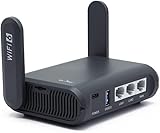
GL.iNet GL-AXT1800 Slate AX
Travel Router
$119.99
Amazon price when we checked on Oct 9, 2026
Check today's price on Amazon(opens Amazon in a new tab)What accessories actually matter
A lot of "Starlink RV accessories" lists are padded. Here's what makes a real difference:
Mount (required): Already covered above. Don't skip this.
Travel router (highly recommended for large rigs): The GL.iNet Slate AX is the most popular choice. It extends WiFi range through a larger rig, adds VPN support, and handles wired connections. If your rig is under 25 feet, the dish's built-in WiFi probably reaches everywhere.
Weatherproof cable pass-through (recommended for permanent installs): A waterproof RJ45 bulkhead connector (an IP67 Cat6 panel-mount feed-through, sold as a 2-pack) gives you a clean, weatherproof way to run a network cable from outside to inside. Starlink's Gen 3 and Mini cables use RJ45-based ends inside sealed, latching housings, and a bare RJ45 joint isn't weather-sealed, so pair the bulkhead with a waterproof Starlink Ethernet adapter or a carefully sealed re-terminated cable. Far cleaner than running cable under a door.
Cable protection (recommended for exterior runs): Self-amalgamating silicone tape wrapped around outdoor connectors keeps moisture out and extends connector life.
Portable power station (for the Mini): If you boondock and want a battery backup for the dish, the 288Wh Anker SOLIX C300 (about $315-380) can run the Mini for roughly 8-10 hours on a single charge.
Surge protector: Shore power at campgrounds isn't always clean. A Tripp Lite Isobar protects your hardware from voltage spikes.
Ethernet cable for the Mini (recommended if you add a travel router): The Starlink Mini has one latching Ethernet LAN port, sealed by the Starlink Plug in the box, but no Ethernet cable. To wire it into a travel router or a desktop, use the Mini Starlink cable (sold separately at shop.starlink.com) or a standard Ethernet cable, which means the Mini is no longer rated IP67. For a weatherproof extension or splice, a waterproof coupler such as the EAZUSE Gen 3/Mini adapter (about $28-33) helps. The Gen 3 router already has two Ethernet ports.
Carrying case (recommended for portable setups): A padded case protects the dish during travel. This matters most for the Mini, which RVers tend to toss loose into storage compartments. See our dish storage and protection guide for options.
Cellular failover (for remote workers who can't drop offline): If losing connectivity isn't an option, a router with cellular failover switches to LTE/5G when Starlink drops. The Peplink Balance 20X ($400-600) is the bulletproof dual-WAN choice; the GL.iNet Puli AX (~$390-460) is a dual-SIM 5G router with a built-in battery that also handles failover. See our Starlink cellular failover guide.

MYZHRE Starlink Cable Routing Kit
Cable Management
Complete cable routing kit with silicone grommets, drill bits, and wall clamps designed specifically for Starlink RV installations.
$16.99
Amazon price when we checked on Oct 9, 2026
Check today's price on Amazon(opens Amazon in a new tab)
STARGEAR Starlink Gen 3 Carrying Case
Carrying Case
Hard EVA travel case custom-fit for Gen 3 dish, router, and accessories with shoulder strap for RV and camping trips.
$89.99
Amazon price when we checked on Oct 9, 2026
Check today's price on Amazon(opens Amazon in a new tab)Setup overview: what to expect
Setting up Starlink on an RV for the first time takes most people 30-60 minutes.
Step 1: Order hardware and select the Roam plan at starlink.com. Hardware typically ships within a week.
Step 2: Download the Starlink app before the hardware arrives. Run the obstruction checker to find the best mounting position on your rig.
Step 3: Mount the dish. For a first-time setup, a portable tripod lets you experiment with placement before committing to a permanent mount.
Step 4: Run the cable inside. For a temporary setup, running it under a closed window works. For a permanent setup, use a cable pass-through.
Step 5: Power on the dish and connect through the app. Initial setup and firmware updates take 15-30 minutes.
For a full step-by-step walkthrough with photos, see our Starlink Mini RV setup guide or the Gen 3 accessory checklist.
Common buying mistakes to avoid
Skipping the mount: You can't just lay the dish flat on the roof. It needs a clear 110-degree sky view, which usually means elevation above roofline obstructions.
Buying Residential instead of Roam: Residential locks you to a home address and loses most of its value the moment you leave that location. Always buy Roam for RV use.
Underestimating power needs for Gen 3: If you're boondocking, the Gen 3's 75-100W draw needs to fit into your energy budget. Check your solar and battery capacity before assuming it will work without upgrades.
Over-buying for occasional use: If you camp a few weekends a year, the Mini on a Roam 100GB plan at $55/month is probably all you need. Don't buy Roam Unlimited until you know you'll use more than 100GB — and if you land somewhere in between, the $80/month Roam 300GB tier may be the sweet spot.
Not using Standby Mode: If you don't camp year-round, Standby Mode saves hundreds of dollars annually. Set a calendar reminder to activate it at the end of each season.
Frequently asked questions
Is Starlink worth it for RV?
Yes — for most full-timers and frequent campers in areas with weak cellular coverage, Starlink pays for itself quickly. You avoid $10-20/day campground Wi-Fi fees, eliminate the need for a cellular hotspot plan, and gain reliable connectivity for remote work. The hardware pays back within one full travel season for most users on Roam Unlimited. For occasional campers, the Mini on Roam 100GB at $55/month with Standby Mode in the off-season is a low-risk entry point.
Can you use Starlink while driving?
Technically yes with a Roam plan — Starlink permits in-motion use as long as the dish is secured in an approved mount. The dish can track satellites while your RV is moving. In practice, signal degrades behind tall trees, overpasses, and in mountain passes. Most RVers don't keep it actively streaming while driving but some use it for passenger devices. Do not mount the dish in a way that violates local laws about objects protruding from vehicles.
What is the Starlink RV kit price?
In 2026: the Mini kit lists at $249 (often $199 on sale) and the Gen 3 Standard kit is $349. You'll also need a mount ($40-150) and a monthly Roam plan ($55-175/month, with a $80/month 300GB tier in between). All-in, a first-year Mini setup on Roam 100GB (seasonal use with Standby) costs approximately $750-900. A full-time Gen 3 setup on Roam Unlimited runs approximately $2,600-2,750 for the first year.
Do I need a separate router for Starlink RV?
The Mini has a router built in. The Gen 3 comes with a separate WiFi 6 router. For rigs under 30 feet, the included WiFi is usually sufficient. For larger rigs or if you want VPN, guest networks, or extended coverage, a travel router like the GL.iNet Slate AX is worth adding.
Can I switch between Roam and Residential?
You can change your service plan from the Starlink app or website. If you want to use the hardware at a fixed home address in winter and on the road in summer, you can switch between plan types — but check current plan switching terms on Starlink's website as these policies have changed over time.
How long does it take to set up Starlink at a campsite?
With a portable tripod, most experienced users can deploy in under 10 minutes: unfold tripod, place dish, plug in cable, connect phone to Starlink WiFi. First-time setup (account activation, firmware update) takes 20-40 minutes. After the first setup, it's fast every time.
Where to buy
Order hardware directly from starlink.com, or from retailers such as Best Buy and Home Depot that carry Starlink kits. Retail prices generally track Starlink's own, so compare before you buy and watch for sales on the Mini.
For accessories like mounts, travel routers, and cable management supplies, Amazon has the best selection and return policy. All products linked in this guide ship to most RV-accessible addresses and have solid return windows if something doesn't fit your rig.
Once the dish is mounted and running, it's worth checking whether your RV insurance covers the Starlink hardware — a $249-349 dish is worth protecting.
What to do next
- Decide between the Mini and Gen 3 based on how often you move and how much power you can spare.
- Order your mount with the dish so you can install everything in one session.
- Budget roughly $400 (Mini with a basic mount) to $850 (Gen 3 with a router and accessories) all-in for hardware plus the first month of Roam service.
Related reading
- Starlink Mini vs Gen 3 for RV
- Best No-Drill Starlink RV Mounts
- Starlink RV Plans and Pricing 2026
- Best 12V Power Setup for Starlink RV
- How to Set Up Starlink on an RV
- Best Travel Routers for Starlink RV
- Best Portable Power Stations for Starlink RV
- Does RV Insurance Cover Starlink Dish Damage?
Affiliate disclosure
This page may include affiliate links. If you purchase through them, we may earn a commission at no extra cost to you.