Starlink pole mount height for RV setups is the vertical distance between the dish and the ground (or roofline) chosen to clear tree canopy and campsite obstructions. If your Starlink keeps dropping at tree-lined campsites, the first question isn't which mount — it's how high. Pole height trades directly against obstruction percentage, wind risk, and cable length. Get one of those wrong and the other two punish you.
In short: open sites need 4–8 ft, mild canopy 10–12 ft, mixed pines 16–20 ft, and anything denser means relocating the dish, not extending the pole. This guide gives you real numbers: the trigonometry behind tree obstructions, the ~20 ft diminishing-returns threshold, the new April 2026 FCC elevation angle rules, and specific pole picks for Gen 3 vs. Mini. If you only remember one thing: taller isn't always better — it's better only up to the point where wind load, cable length, and stability stop cooperating.
For the broader obstruction playbook, pair this with our Starlink RV obstruction tips guide.
How high does a Starlink pole need to be on an RV?
There's no universal answer, but there is a good decision table. The right height depends on what's blocking your sky, not on the pole catalog.
| Site type | Typical dish height | Mount style |
|---|---|---|
| Open site, full sky | 4–8 ft | Ground spike, tripod, or low ladder mount |
| Mild campground canopy | 10–12 ft | Ladder mount or short hitch pole |
| Mixed pines / partial forest | 16–20 ft | Tall hitch pole, flag-pole class, guyed |
| Dense forest / tall pines close in | Relocate — don't extend | Portable tripod placed in a clearing |
Two things changed the math in 2026. First, the FCC approved Starlink's request to drop the minimum elevation angle from 25° down to 10° for sub-400 km satellites and 20° for 400–500 km satellites, effective mid-April 2026. More low sky is usable now, so marginal sites that were hopeless in 2025 may work fine at 10–12 ft in 2026. Second, the new Gen 3 dish has a larger sail area than Gen 2, which punishes tall, unguyed poles harder.
If you primarily boondock in wooded sites, the elevation change is genuinely good news — read our Starlink RV boondocking guide for how to plan sites around it.
The math: tree height vs. pole height vs. distance
The bottom line: the blocked elevation angle is set by the ratio of tree height above the dish to the horizontal distance between them. Here is the formula the Starlink app is running behind the scenes when it flags an obstruction:
elevation angle blocked = arctan( (obstacle_height - dish_height) / horizontal_distance )
Any satellite lower in the sky than that angle, behind that obstacle, is blocked. A worked example:
- A 60 ft pine tree, 75 ft from your rig.
- Dish at 4 ft (roof or kickstand):
arctan((60-4)/75)= ~37° blocked. - Dish at 12 ft (ladder mount):
arctan((60-12)/75)= ~33° blocked. - Dish at 20 ft (tall hitch pole):
arctan((60-20)/75)= ~28° blocked.
Going from 4 ft to 12 ft bought you 4°. Going from 12 ft to 20 ft bought you another 5°. With the new 10° minimum elevation angle, a 28° blocked region still leaves a big usable window — but those gains shrink fast. Look at the same tree at 150 ft:
- Dish at 4 ft: ~20° blocked.
- Dish at 20 ft: ~15° blocked.
At long distances, even a huge pole height change barely moves the angle. Distance dominates, not height. This is why experienced boondockers relocate the dish with a long cable run instead of stacking pole extensions.
The ~20 ft diminishing-returns threshold
There's a practical ceiling around 20 ft for three reasons stacked on top of each other:
- Wind leverage. A Gen 3's 23.4" × 15.1" flat panel at 20 ft has a huge torque arm. Forum consensus on iRV2 and Airstream is that anything past 15 ft needs guy lines; past 20 ft, you're building an antenna mast.
- Cable budget. The Gen 3 ships with a 50 ft cable. A 20 ft vertical plus 25 ft horizontal plus slack for routing eats that budget fast.
- Angle gains collapse. As the worked examples show, the delta per extra foot of pole is tiny past 20 ft unless the tree is very close.
If your 20 ft pole isn't solving the problem, the fix isn't 30 ft. The fix is walking the dish to a clearing.
Pole mount vs. tripod vs. ground spike vs. hitch pole
Four deployment styles, four different use cases. Pick by dish model first, then by site.
| Style | Best for | Height range | Wind tolerance | Dish compat |
|---|---|---|---|---|
| Hitch pole (attached to RV) | Weekly boondockers, quick deploy | 6–20 ft | Good (RV mass as anchor) | Gen 3, Mini |
| Ladder mount | Rigs with rear round-rung ladder | 8–12 ft | Good (two-point) | Gen 3, Mini |
| Ground spike / stake | Mini users, open soft ground | 3–6 ft | Fair | Mini preferred |
| Tripod | Any rig, uneven ground, trees 30+ ft away | 4–10 ft | Fair (ballast required) | Mini; Gen 3 with 20–40 lb ballast |
| Flag-pole class (Harbor Freight 20 ft) | Heavy obstruction, semi-permanent site | 16–20 ft | Poor without guy lines | Gen 3 with care |
For the detailed ladder-vs-hitch trade-offs, see our ladder mount vs hitch mount Starlink RV comparison. If you can't drill, review the best no-drill Starlink RV mounts.
The Mini is forgiving — a 2.4 lb dish works on almost anything with a flat top. The Gen 3 at ~6.4 lb with a large flat profile is the one that demands a serious base. If you haven't picked a dish yet, the weight delta is a real factor — see our Starlink Mini vs Gen 3 for RV breakdown.
Starlink's official pipe adapter specs (and what actually fits)
The single most-missed spec in pole shopping is adapter bore diameter. Here's the cheat sheet:
- Starlink Gen 3 Standard Pipe Adapter: fits metal pipe with an OD of 1.25 in to 2.5 in (about 32–64 mm) and a 3.6 mm minimum wall. No PVC.
- Third-party adapters on Amazon: ranges vary by listing, so check the stated OD range against your pole before you buy.
- Harbor Freight 20 ft telescoping flag pole base OD: 2.375 in (~60 mm). That is inside the official diameter range, but the dish sits on the narrower, thin-walled top section, so plan for bar clamps or a third-party adapter there.
Most "universal" RV pole kits sell at 1.5 in OD because it sits squarely in the official adapter range. That's the safe default, as long as the wall meets the 3.6 mm minimum.
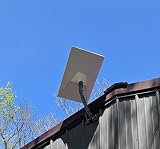
Starlink Gen 3 Pipe Adapter + J-Pole Combo Kit
Pipe/Pole Mount
All-in-one pipe adapter and J-pole mount for Gen 3 dish with two height configurations, fits standard antenna masts on RVs.
$50.00
Amazon price when we checked on Oct 9, 2026
Check today's price on Amazon(opens Amazon in a new tab)This combo kit is the most foolproof starting point for Gen 3 owners. It includes the pipe adapter plus a J-pole with two height configurations. If you're piecing together your own pole, you still want this adapter at the top.
Best pole mounts and tripods for RV use in 2026
Here's the short list, organized by how tall you need to go.
4–8 ft: short hitch pole or ground anchor
For open sites or mild canopy, a 5–6 ft pole with a ground anchor is plenty. Widely available on Amazon for $40–60 — search "Starlink pole mount Gen 3 ground anchor". These typically come as 1.5 in OD tubes, 5.3 ft tall, with a no-dig spike base and the V3 pipe adapter preinstalled.
If you'd rather build your own rigid mast, a 5 ft galvanized steel mast pipe (1.25 in OD, swedged ends so sections stack) is far stiffer than a cheap aluminum pole — galvanized steel resists the crosswind flex that tips a Gen 3, and 1.25 in sits at the bottom of the official pipe adapter range. Check the listed wall thickness against Starlink's 3.6 mm minimum before you rely on it for a Gen 3.

5 ft Galvanized Steel Antenna Mast (1.25 in OD)
Mount
$25.00
Amazon price when we checked on Oct 9, 2026
Check today's price on Amazon(opens Amazon in a new tab)8–12 ft: hitch pole or ladder mount
For most RVers, this range covers 80% of real-world campsites. A hitch-mounted flag pole is the most versatile option because the RV itself is the anchor.

EEZ RV Starlink Hitch Pole Mount
Hitch Mount
$75.00
Amazon price when we checked on Oct 9, 2026
Check today's price on Amazon(opens Amazon in a new tab)The EEZ RV hitch mount slides into a 2 in receiver and holds a pole up to 2.5 in, with no drilling. You supply the pole and a dish pipe adapter, so the height depends on the pole you pick. For rigs where the hitch is occupied (bike rack, cargo carrier), an adjustable wall or roof bracket for the Standard Gen 3 dish is the way round it, though it bolts on and needs drilling:

Adjustable Wall/Roof Mount for Starlink Standard Gen 3/4/4X
Mount
Adjustable bracket with the aluminium pipe adapter included, so it clamps to a wall, roof edge, or pole without buying a separate adapter. The most-reviewed Starlink mount on Amazon by a wide margin.
$28.49
Amazon price when we checked on Oct 9, 2026
Check today's price on Amazon(opens Amazon in a new tab)16–20 ft: flag-pole class for heavy obstruction
This is where the Harbor Freight $50 telescoping flag pole enters the conversation. It works, but not out of the box:
- The problem: the dish mounts on the narrow, thin-walled top section, not the 2.375 in base, and Starlink's adapter wants metal pipe with a 3.6 mm minimum wall.
- The fix: bar clamps sized to the top section, or a third-party adapter rated for that diameter, such as this Starlink Gen 3 pipe adapter and J-pole kit.
- The other problem: 20 ft of unguyed aluminum with a 6 lb Gen 3 on top sways visibly in 10 mph gusts. Plan for three guy lines at 2/3 height.
If you want a turn-key 20 ft solution without DIY, search "20 ft telescoping flag pole Starlink adapter" — several purpose-built kits now bundle the pole, adapter, and guy-line hardware.
Tripod for Mini users
Mini users get the easiest path: a heavy-duty camera tripod or a dedicated ground-spike mount. The packable Anautin telescopic tripod (stainless steel, adjustable height, 360° tilt ball head) is purpose-sized for the Mini and sets it on the ground in seconds. The Mini's 2.4 lb weight makes this genuinely plug-and-play.

Anautin Starlink Mini Telescoping Tripod Mount
Mount
$31 – $38
Amazon price when we checked on Oct 9, 2026
Check today's price on Amazon(opens Amazon in a new tab)Wind, weight, and keeping it standing
A pole is only as useful as its base. Three thresholds worth remembering:
- Below 10 ft: unguyed is fine if the base is rigid (hitch receiver, ladder bracket, heavy tripod).
- 10–15 ft: add a single guy line or a ballasted tripod (20 lb minimum on the spreader).
- Above 15 ft: three guy lines at 120° spacing, anchored at 2/3 pole height. This is non-negotiable for Gen 3.
The Gen 3 sail area is the hidden villain here. Its 24.7" × 16.6" flat panel catches crosswinds like a rudder. The Mini, at roughly a third of the surface area and well under half the weight, tolerates much more flex in the pole before it tips the dish enough to cause dropouts.
Cold weather and wet snow add their own loads — our Starlink RV cold weather and rain guide covers accumulation thresholds. If you leave the dish out through freezing rain, the silicone cover helps:

Starlink Gen 3 Silicone Protective Cover
Dish Cover
Waterproof silicone cover shields Gen 3 dish from hail, snow, UV, and debris without blocking signal.
$20 – $35
Amazon price when we checked on Oct 9, 2026
Check today's price on Amazon(opens Amazon in a new tab)Cable length planning for tall pole mounts
Every foot you go up is a foot you don't have for lateral reach. Here's the budget:
- Gen 3 stock cable: 50 ft (15 m), detachable.
- Longer cables: Starlink sells a 150 ft (45 m) cable, and third-party lengths exist — search "Starlink 75 ft cable Gen 3".
- Realistic math: 20 ft pole + 25 ft horizontal to RV + 5 ft slack/routing = 50 ft gone before you're inside the rig.
If your dish placement needs more than ~35 ft of horizontal distance from the router, you need the 75 ft or 150 ft cable — plan that purchase at the same time as the pole, not after.
Strain relief matters more on tall poles because wind flex pulls on the connector. A proper cable routing kit adds grommets and clamps that keep the connector happy:

MYZHRE Starlink Cable Routing Kit
Cable Management
Complete cable routing kit with silicone grommets, drill bits, and wall clamps designed specifically for Starlink RV installations.
$16.99
Amazon price when we checked on Oct 9, 2026
Check today's price on Amazon(opens Amazon in a new tab)Full walkthrough in our Starlink RV cable routing guide.
Power and placement considerations
Pole height doesn't change your 12V draw, but long cable runs do introduce small IR losses. At 150 ft you'll see a few hundred millivolts of drop under load — not enough to matter for Gen 3's power budget, but worth noting if your inverter is already marginal.
Placement is the lever most RVers underuse. A 10 ft pole in a 30 ft pull-through clearing will beat a 20 ft pole parked directly under a pine canopy every single time. Before you buy a taller pole, walk the site with the dish and run the Starlink app's "Check for Obstructions" AR scan from three candidate spots. The scan takes about 2 minutes per position; repeat after every height or location change.
If you run Mini as a portable and Gen 3 as the roof-mounted primary, pole strategy is cheaper and simpler — the Mini is what goes on the pole, leaving the Gen 3 permanent.
Related reading
- Starlink RV obstruction tips
- Starlink RV boondocking guide
- Ladder mount vs hitch mount Starlink RV
- Best no-drill Starlink RV mounts
- Starlink RV cable routing guide
- Starlink Mini vs Gen 3 for RV
- Starlink RV cold weather and rain
What to do next
- Measure before you buy. Use the Starlink app's obstruction scan at dish-head height in 2–3 candidate spots. The app will tell you your actual blocked percentage — don't guess.
- Pick your height tier. Open site → 4–8 ft. Mild canopy → 10–12 ft. Mixed pines → 16–20 ft. Dense forest → relocate, don't extend.
- Match adapter to pole OD. Stay inside the official 1.25–2.5 in range (metal pipe, 3.6 mm minimum wall) unless you already own a 20 ft flag pole and budgeted for bar clamps.
- Buy the cable with the pole. If your pole height plus horizontal distance exceeds ~35 ft, order the 75 ft aftermarket cable at the same time.
- Plan guy lines above 15 ft. Three lines, 120° spacing, anchored at 2/3 pole height.
Affiliate disclosure
This page may include affiliate links. If you purchase through them, we may earn a commission at no extra cost to you. Amazon links use the tag starlinkrvkit-20.