Why portable power stations work for Starlink RV
Portable power stations solve a specific problem: you want to run Starlink away from shore power without permanently modifying your RV electrical system. Maybe you rent your RV, camp out of a truck bed, or simply want a grab-and-go kit that moves between vehicles.
The concept is simple. A portable power station is a lithium battery, inverter, charge controller, and output ports in a single box. Plug your Starlink dish in, and it runs until the battery depletes. Recharge from a wall outlet, 12V car port, or portable solar panel.
The practical challenge is sizing. Starlink draws more power than most portable electronics, and it runs for hours — not minutes. Picking a station that is too small means constant recharging, while oversized stations cost more and weigh more than necessary.
This guide breaks down exactly what capacity you need for each Starlink model, compares the best stations available in 2026, and shows you how to pair them with solar for extended off-grid sessions.
Power station sizing for Starlink
Before comparing specific products, you need to know exactly how much capacity your setup demands.
Starlink Mini power requirements
| Metric | Value |
|---|---|
| Average draw | 20–40W (15W idle) |
| Daily consumption (12 hrs) | 240–480Wh |
| Daily consumption (24 hrs) | 480–960Wh |
| Peak draw (startup) | ~60W |
| Input voltage | 12–48V DC or 100W (20V/5A) USB-C PD |
The Mini is remarkably efficient. A 500Wh station runs it for roughly 10–20 hours depending on conditions. Cold weather pushes draw toward the high end.
Starlink Standard Gen 3 power requirements
| Metric | Value |
|---|---|
| Average draw | 75–100W |
| Daily consumption (12 hrs) | 900–1,200Wh |
| Daily consumption (24 hrs) | 1,800–2,400Wh |
| Peak draw (snow melt mode) | ~150W |
| Input | AC only (standard power supply) |
The Standard needs significantly more capacity. For a realistic day-trip or weekend session, plan on 1,000Wh minimum.
Capacity rule of thumb
Multiply your Starlink's average wattage by the hours you plan to run it, then add 20% for inverter efficiency losses and battery chemistry overhead. That gives you the minimum station capacity in Wh.
For example: Starlink Standard at 85W average × 10 hours = 850Wh + 20% = 1,020Wh minimum.
Best portable power stations for Starlink Mini
The Mini's low power draw and DC input capability open up smaller, lighter, and less expensive options than the Standard requires.

Anker SOLIX C300 (288 Wh)
Power Station
$329.99
Amazon price when we checked on Oct 9, 2026
Check today's price on Amazon(opens Amazon in a new tab)
Jackery Explorer 1000 v2 (1,070 Wh)
Power Station
$559.00
Amazon price when we checked on Oct 9, 2026
Check today's price on Amazon(opens Amazon in a new tab)Anker SOLIX C300 — compact pick for short sessions
| Spec | Value |
|---|---|
| Capacity | 288Wh (LiFePO4) |
| Weight | 4.1 kg (9.1 lb) |
| AC output | 300W pure sine wave |
| DC output | 12V car port, USB-C 140W |
| Solar input | 100W max |
| Price range | $315–$380 |
For short sessions — a few hours of internet at a trailhead or day-trip campsite — the SOLIX C300 runs the Mini for roughly 6–12 hours. At about 4 kg, it fits in a backpack alongside the Mini itself. Its 140W USB-C ports clear the Mini's 100W USB-C PD requirement, so you can skip the AC inverter and run the dish from USB-C or the 12V car port.
Limitation: the 288Wh capacity means overnight use is not practical without solar supplementation.
Anker SOLIX C300 (288 Wh)
Power Station
$329.99
Amazon price when we checked on Oct 9, 2026
Check today's price on Amazon(opens Amazon in a new tab)Jackery Explorer 1000 v2 — Mini all day, with extras
If you also want to run a laptop, charge devices, and power a small 12V fridge alongside the Mini, step up to a 1,000Wh-class station. The Jackery Explorer 1000 v2 (full specs in the Standard section below) runs the Mini for well over a day and still has headroom for the rest of your gear. It also works for the Standard Gen 3 during the day.
Older favorites for this slot, the EcoFlow RIVER 2 Pro, Jackery Explorer 300 Plus and Bluetti AC180, have been discontinued. If you already own one, it still runs the Mini fine; just don't pay full price for leftover stock.
Best portable power stations for Starlink Standard Gen 3
The Standard's higher power draw requires stations with at least 1,000Wh capacity for meaningful runtime.

EcoFlow DELTA 2 Max (2,048 Wh)
Power Station
$1,029.00
Amazon price when we checked on Oct 9, 2026
Check today's price on Amazon(opens Amazon in a new tab)Jackery Explorer 1000 v2 (1,070 Wh)
Power Station
$559.00
Amazon price when we checked on Oct 9, 2026
Check today's price on Amazon(opens Amazon in a new tab)
Bluetti Elite 200 V2 (2,073 Wh)
Power Station
$899.00
Amazon price when we checked on Oct 9, 2026
Check today's price on Amazon(opens Amazon in a new tab)EcoFlow DELTA 2 Max — best overall
| Spec | Value |
|---|---|
| Capacity | 2,048Wh |
| Weight | 23 kg (50.7 lb) |
| AC output | 2,400W pure sine wave |
| DC output | 12.6V/10A, USB-C 100W |
| Solar input | 1,000W max (two 500W inputs) |
| Recharge time (AC) | ~80 minutes |
| Price range | $990–$1,160 |
The DELTA 2 Max runs the Starlink Standard for 17–22 hours on a single charge. Paired with two 200W portable solar panels, you can achieve near-indefinite runtime on sunny days.
At 23 kg, it is not something you casually carry around, but it fits nicely in an RV basement compartment or truck bed.
Key advantage: expandable to 6,144Wh with add-on batteries for multi-day boondocking without solar.
Jackery Explorer 1000 v2 — best balance of weight and capacity
| Spec | Value |
|---|---|
| Capacity | 1,070Wh |
| Weight | 10.8 kg (23.8 lb) |
| AC output | 1,500W pure sine wave |
| DC output | 12V/10A, USB-C 100W |
| Solar input | 400W max |
| Recharge time (AC) | ~1.7 hours |
| Price range | $460–$540 |
The Explorer 1000 v2 replaced the discontinued Explorer 1000 Plus, and the swap is mostly good news: it is 3.7 kg lighter and roughly half the price, with an LFP cell pack rated for far more cycles. You give up some capacity (1,070Wh vs 1,264Wh) and peak AC output.
At 1,070Wh it runs a Starlink Standard for 10–13 hours, or a Mini for well over a day. If you run the dish during working hours and recharge at shore power or from solar overnight, this is the best weight-to-capacity ratio in the roundup.
Bluetti Elite 200 V2 — the 2kWh alternative
| Spec | Value |
|---|---|
| Capacity | 2,073.6Wh (LiFePO4) |
| Weight | 24.2 kg (53.4 lb) |
| AC output | 2,600W pure sine wave |
| Solar input | 1,000W max |
| AC charging | up to 1,800W |
| Price range | $850–$1,030 |
The Elite 200 V2 matches the DELTA 2 Max on capacity, usually for a little less money, and its 1,000W solar input means you can lean on panels as your primary recharge source. It replaces the discontinued Bluetti AC200MAX in this slot.
Best power stations for full-time off-grid
Everything above assumes you plug back into shore power every few days. If you are boondocking for a week or working full-time from the rig, a 2,000Wh station becomes the thing you ration around rather than the thing that solves the problem. At that point you want 3,000Wh or more.
The maths is simple. A Standard Gen 3 dish pulling an average 85W consumes about 2,040Wh per day. On a 2,048Wh station that is roughly one day with nothing else running. On a 3,600Wh station it is closer to two days for the dish alone — and enough headroom left over that a laptop, monitor, and fridge do not force you to choose.

EcoFlow DELTA Pro 3600Wh Portable Power Station
Power Station
3,600Wh is roughly three days of continuous Starlink plus a full mobile-office load, with no wiring and no install. The highest-rated big-capacity station on Amazon and the simplest path to real off-grid uptime.
$1,899.00
Amazon price when we checked on Oct 9, 2026
Check today's price on Amazon(opens Amazon in a new tab)
EcoFlow DELTA Pro 3600Wh with 400W Solar Panel
Power Station
The DELTA Pro bundled with a 400W folding panel - buying them together saves against separate purchase and gives you a closed loop that recharges itself indefinitely while boondocking.
$2,399.00
Amazon price when we checked on Oct 9, 2026
Check today's price on Amazon(opens Amazon in a new tab)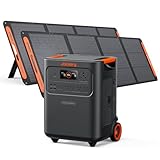
Jackery HomePower 3600 Plus with 2x 200W Solar Panels
Power Station
Jackery's answer to the DELTA Pro, with two 200W panels included and an LFP pack rated for far more cycles than older lithium-ion stations. Expandable to 21kWh if you later add batteries.
$2,549.00
Amazon price when we checked on Oct 9, 2026
Check today's price on Amazon(opens Amazon in a new tab)EcoFlow DELTA Pro — best for full-time work from the rig
EcoFlow DELTA Pro 3600Wh Portable Power Station
Power Station
3,600Wh is roughly three days of continuous Starlink plus a full mobile-office load, with no wiring and no install. The highest-rated big-capacity station on Amazon and the simplest path to real off-grid uptime.
$1,899.00
Amazon price when we checked on Oct 9, 2026
Check today's price on Amazon(opens Amazon in a new tab)At 3,600Wh the DELTA Pro roughly doubles the DELTA 2 Max, and the 3,600W AC output means you are no longer checking whether a device will trip the inverter. For a full-timer whose income depends on the dish staying up, this is the point where power stops being a daily calculation.
The trade-off is weight — 45 kg (99 lb) with wheels and a pull handle, so it lives in one place in the rig rather than moving to a picnic table. Expandable to 25kWh with extra batteries if you later want whole-rig backup.
EcoFlow DELTA Pro with 400W solar — the self-sufficient bundle
EcoFlow DELTA Pro 3600Wh with 400W Solar Panel
Power Station
The DELTA Pro bundled with a 400W folding panel - buying them together saves against separate purchase and gives you a closed loop that recharges itself indefinitely while boondocking.
$2,399.00
Amazon price when we checked on Oct 9, 2026
Check today's price on Amazon(opens Amazon in a new tab)The same station bundled with a 400W folding panel. Buying them together costs less than the two separately, and it closes the loop: 400W of panel roughly covers a Gen 3 dish's daily draw in good sun, so the bank ends most days where it started. This is the kit that lets you stay put indefinitely.
Jackery HomePower 3600 Plus — the LFP alternative
Jackery HomePower 3600 Plus with 2x 200W Solar Panels
Power Station
Jackery's answer to the DELTA Pro, with two 200W panels included and an LFP pack rated for far more cycles than older lithium-ion stations. Expandable to 21kWh if you later add batteries.
$2,549.00
Amazon price when we checked on Oct 9, 2026
Check today's price on Amazon(opens Amazon in a new tab)Comparable capacity to the DELTA Pro with two 200W panels in the box, built on an LFP (LiFePO4) pack rated for far more charge cycles than the older lithium-ion chemistry in some competing stations. If you expect to cycle the battery daily for years rather than seasonally, the chemistry matters more than the spec sheet suggests.
When a station stops making sense
Past roughly $2,000, compare a power station against a wired install — a LiFePO4 house bank plus an inverter delivers more usable watt-hours per dollar and disappears into the rig instead of taking up floor space. See our off-grid power guide for the Starlink Mini and the 12V power setup guide for that route. The station wins on zero installation and portability; the wired bank wins on cost per watt-hour and permanence.
Quick comparison table
| Station | Capacity | Weight | Best for | Price range | Buy |
|---|---|---|---|---|---|
| Anker SOLIX C300 | 288Wh | 4.1 kg | Mini short sessions | $315–$380 | Amazon |
| Jackery Explorer 1000 v2 | 1,070Wh | 10.8 kg | Mini all day, Standard daytime | $460–$540 | Amazon |
| EcoFlow DELTA 2 Max | 2,048Wh | 23 kg | Standard full-day use | $990–$1,160 | Amazon |
| Bluetti Elite 200 V2 | 2,073.6Wh | 24.2 kg | Standard + heavy solar | $850–$1,030 | Amazon |
| EcoFlow DELTA Pro | 3,600Wh | 45 kg | Full-time off-grid work | $1,890–$2,060 | Amazon |
| EcoFlow DELTA Pro + 400W solar | 3,600Wh | 45 kg + panel | Indefinite boondocking | $2,390–$2,600 | Amazon |
| Jackery HomePower 3600 Plus | 3,584Wh | 43 kg + panels | Daily cycling, LFP pack | $2,390–$2,600 | Amazon |
Pairing with portable solar panels
A power station alone gives you a fixed number of hours. Adding portable solar panels turns that fixed budget into a renewable system.
Panel sizing guidelines
| Starlink model | Recommended solar | Why |
|---|---|---|
| Mini (20–40W) | 100–200W panel | A 100W panel in good sun produces 60–80W effective, covering the Mini's draw with surplus for battery charging |
| Standard (75–100W) | 200–400W panels | You need at least 2× the dish draw to cover inefficiency losses and maintain a positive charge balance |
Best portable solar panels for Starlink
EcoFlow 220W Bifacial Panel — folds flat for storage, captures reflected light on the back side, weighs 9.5 kg. Pairs natively with EcoFlow stations via MC4. View on Amazon
Jackery SolarSaga 200W — folds into a briefcase shape, bifacial, with built-in kickstands, weighs about 6.5 kg. Connects directly to Jackery stations. View on Amazon

EcoFlow 220W Bifacial Solar Panel
Solar Panel
$399.00
Amazon price when we checked on Oct 9, 2026
Check today's price on Amazon(opens Amazon in a new tab)
Jackery SolarSaga 200W Solar Panel
Solar Panel
$419.99
Amazon price when we checked on Oct 9, 2026
Check today's price on Amazon(opens Amazon in a new tab)
EcoFlow 400W Portable Foldable Solar Panel
Solar Panel
Folding panel you aim at the sun instead of bolting to the roof - which is the point when you are parked in shade for the trees and need the dish to stay up. Pairs directly with EcoFlow power stations.
$699.00
Amazon price when we checked on Oct 9, 2026
Check today's price on Amazon(opens Amazon in a new tab)If you are running a Standard Gen 3 dish rather than a Mini, a single 200W panel will not keep up — you are covering roughly half the daily draw and slowly losing ground. Step up to 400W:
EcoFlow 400W Portable Foldable Solar Panel
Solar Panel
Folding panel you aim at the sun instead of bolting to the roof - which is the point when you are parked in shade for the trees and need the dish to stay up. Pairs directly with EcoFlow power stations.
$699.00
Amazon price when we checked on Oct 9, 2026
Check today's price on Amazon(opens Amazon in a new tab)One 400W folding panel replaces two 200W panels with a single set of cables and one thing to aim, and it is the pairing EcoFlow designed the DELTA Pro around. The practical advantage over roof-mounted solar is that you can park the rig in shade for the trees and still put the panel out in the sun — which is exactly the situation that also blocks your dish.
Solar charging math example
Running Starlink Standard on a DELTA 2 Max with 400W of portable solar:
- Starlink draws ~85W average = 2,040Wh over 24 hours
- 400W panels produce ~1,600–2,000Wh in 5 effective sun hours
- Net daily deficit: 0–440Wh
- The 2,048Wh battery covers the overnight deficit easily
- Result: multi-day operation without shore power
Tips for maximizing runtime
Use DC output when possible
If you run the Starlink Mini, connect it to the station's 12V DC car port using the appropriate cable. This bypasses the station's AC inverter, which typically wastes 10–15% of stored energy as heat during DC-to-AC-to-DC conversion.
Disable the AC inverter when not needed
Most stations have a button to toggle the AC output on and off. If you are only running the Mini via DC, turn AC off. The inverter itself draws 5–15W of idle power even with nothing plugged in.
Manage standby loads
Power stations have their own standby drain — the screen, Bluetooth, and WiFi features all consume battery. Disable Bluetooth and app connectivity on the station when you do not need remote monitoring.
Use the Starlink app sleep schedule
The Starlink app lets you set a sleep schedule that powers down the dish during hours you are not using internet. If you sleep from 11 PM to 6 AM, that is 7 hours of zero draw — saving roughly 140–700Wh per night depending on the dish model.
Pre-charge strategically
Charge the station to 100% the night before a trip using shore power or a wall outlet. Top off from the vehicle 12V port while driving between campsites. Arrive at each stop with a full battery.
What to avoid
Modified sine wave stations. The Starlink Standard power adapter works best with pure sine wave AC. Modified sine wave causes extra heat and can reduce adapter lifespan. Every station recommended above uses pure sine wave.
Stations under 200Wh for any real use. Small USB power banks and micro-stations cannot sustain even the Mini for a useful work session. The minimum practical size is 300Wh.
Overreliance on car charging. Many stations charge slowly from a 12V car port (50–100W). A 2,000Wh station takes 20–40 hours to fill from a car outlet. Use AC wall charging or solar instead whenever possible.
What to do next
Pick the station that matches your Starlink model and typical session length. Budget for a matching portable solar panel if you boondock regularly — the combination is what turns a portable power station from a limited backup into a genuine off-grid power system.
- Size your full 12V system in Best 12V power setup for Starlink RV
- Learn about off-grid camping with Starlink in Starlink RV boondocking guide
- Compare Standard vs Mini for your power budget in Starlink Mini vs Gen 3 for RV
Related reading
- What a full off-grid Starlink power system costs
- Best RV lithium battery for Starlink off-grid
- Best 12V power setup for Starlink RV
- Starlink RV boondocking guide
- Starlink Mini vs Gen 3 for RV
- Starlink RV plans and pricing
Affiliate disclosure
This page may include affiliate links. If you purchase through them, we may earn a commission at no extra cost to you.